
FG tips gas as driver of power sector, says reforms resolved legacy debts
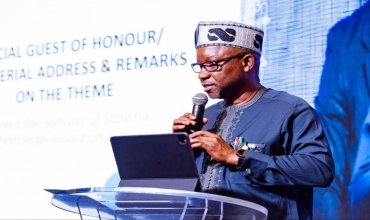
FG tips gas as driver of power sector, says reforms resolved legacy debts
The Minister of State for Petroleum Resources (Gas), Ekperikpe Ekpo, said more than 70 per cent of the country’s grid electricity now depends on natural gas.
This comes as the government positions the resource as the central pillar of power sector recovery and industrial growth backed by debt resolution, domestic supply reform and new infrastructure oversight plans.
Ekpo, at the ongoing Nigeria International Energy Summit (NIES) 2026 in Abuja, said the current administration is restructuring Nigeria’s gas market to support electricity generation, stabilise household energy costs and drive industrialisation, describing gas as the country’s “bridge fuel” in the transition to a lower-carbon economy.
“Natural gas remains central to our transition toward a cleaner, more secure and inclusive energy future. It is our bridge fuel, linking today’s realities with tomorrow’s low-carbon ambition. Gas enables us to expand electricity access, deepen industrialisation, reduce energy poverty and pragmatically meet climate commitments,” he said.
According to him, a key milestone has been the resolution of longstanding debts owed to gas producers supplying power plants, a development he said had stalled investment and constrained gas supply to the electricity sector for years.
The settlement, approved by the President and ratified by the National Economic Council (NEC), is expected to restore investor confidence and unlock new gas volumes for power generation.
The power sector is heavily gas-dependent, with thermal plants accounting for the majority of on-grid generation. However, chronic payment shortfalls and supply disruptions have historically undermined reliability.
The minister said the Federal Government was pursuing long-term, commercially viable gas supply agreements and sustaining implementation of the debt resolution framework to prevent a recurrence.
“Under the Renewed Hope Agenda, this administration is committed to entrenching gas as the backbone of our national energy architecture—supported by institutional reforms, regulatory enhancements, and investment incentives through the Decade of Gas Initiative,” Ekpo added.
He also announced plans to establish a National Gas Infrastructure Command Centre to coordinate and monitor pipelines, processing facilities and related assets nationwide in what officials describe as an effort to reduce bottlenecks and improve system efficiency across the gas-to-power value chain.
Beyond power generation, the government is seeking to redirect more domestically produced gas toward local consumption.
Ekpo said authorities had pushed upstream producers to supply more liquefied petroleum gas (LPG) into the domestic market, a move he linked to improved availability and relative price stability for cooking gas, a key household fuel.
He added that the nationwide rollout of a free LPG cylinder distribution programme across the six geopolitical zones is aimed at accelerating the shift to cleaner cooking, reducing reliance on firewood and kerosene and improving public health outcomes.
The initiative is also being framed as part of Nigeria’s broader climate and deforestation reduction efforts, he added.
“Our strategic focus includes; long term commercially viable gas supply agreements for power plants, sustained implementation of the NEC approved debt resolution framework, expansion of critical infrastructure like pipelines, processing plants, and metering systems; deepened collaboration with the power sector to eliminate bottlenecks, establishment of a National Gas Infrastructure Command Centre to monitor, coordinate, and optimize gas infrastructure nationwide, as approved by President Tinubu,” he highlighted.
On the industrial front, he mentioned that the government is promoting gas-based industrial hubs and wider use of compressed natural gas (CNG) and LPG in transport, small businesses and manufacturing.
He added that this approach is intended to move the country from primarily exporting raw gas to using it as feedstock for domestic value addition in sectors such as petrochemicals, fertiliser and manufacturing.